Urban MattersIssue 3, 2022
Dislocating Urban StudiesResearch article
Segregation and Landscape Injustice in the Shadows of White Planning and Green Exceptionalism in Sweden

 Burcu Yigit Turan and Mia Ågren
Abstract
We write this article deriving from our work “White landscapes: tracing socio-spatial epistemologies of Whiteness in contemporary Swedish planning” ¹ presented in the session “A Non-Occidentalist West: Learning from Theories Outside the Canon” of the “Dislocating Urban Studies” Workshop Series…
- Published
- May 11, 2022
- Reading time
- 14 min
The PDF isn’t ready yet.
We write this article deriving from our work “White landscapes: tracing socio-spatial epistemologies of Whiteness in contemporary Swedish planning”1 presented in the session “A Non-Occidentalist West: Learning from Theories Outside the Canon” of the “Dislocating Urban Studies” Workshop Series (Malmö University) in 2021.
Our research is driven by a frustrating paradox: that the dominant planning discourse in Sweden is planning “for all”, but at the same time conforms with hierarchical representations of residential neighborhoods in public media, particularly on the fault lines of ‘ethnicity/race’ where neighborhoods produced within the Million Homes Programme2 are stigmatized (see Backvall 2019) and how people, who are living in those areas, feel about their neighborhood3. Our concern allies here particularly with the analysis brought by the Swedish Black Lives Matter Movement which was flamed by events in the USA in 2020 in the face of George Floyd’s murder 4. The voices within the movement problematize the portrayal of Million Homes neighborhoods as ‘no-go-zones’ by the public media, address the necessity to better understand the Swedish segregation’s structural and institutional root causes and the actual lived realities of BIPoC 5 people intersectionally in Sweden 6. In planning policy and practice, it is very common to address social vision through abstract concepts such as ‘housing for all’, ‘planning for all’, ‘green space for everyone’, without any mention to what is defined as injustice and how specific historical structures of inequality will be addressed. This reminds us of the ‘all lives matter’ claim, which emerged as a backlash to the Black Lives Matter Movement, and we ask if this notion in planning as a rhetorical instrument functions to obscure the problems and maintain class, race, gender privileges and inequalities as they are.
In our empirical research, we explore whether landscape planning and design discourse and practices in Uppsala, Sweden mirrors a stigmatizing discourse, or not, while claiming to treat all residents equally in overarching planning documents. Against this background, we observe a lack and avoidance of theory and language capturing how power, race and planning intersect in reproducing contemporary urban landscapes 7. Our experience with landscape planning literature in Sweden resonates with bell hooks’ (2011) depiction of how black feminist scholars encountered dominant theories in White academia by reading mainstream theory with a feeling that it does not connect to our observations of the lived socio-spatial realities of those who are marginalized in society. The roots of this absence are the canon that we attempt to define and counter in this text. We delineate the particularities of the canon and its wider historical context, and why and how our work dislocates it by drawing on Black geographic thought and Critical Whiteness Studies.
Swedish cities are, by Swedish sociologist urban studies scholars Thörn and Thörn (2017, 293), described as “belong[ing] to the most segregated in Europe”. Sweden’s spatial segregation has been a manifestation of racializing and discriminatory social processes and cultural practices (McEachrane 2019; Pred 2000). Its pattern reflects the racial, ethnic and class hierarchies in the labor market (Andersson et al. 2010). Individuals with non-European foreign background constitute the majority in the poor Million Programme areas at the peripheries of the cities (ibid). Almost every day, debates in the public sphere problematize Million Programme areas and individuals of ethnic and racial minorities in an othering 8 and stigmatizing rhetoric obscuring the structural mechanisms which (re)produce those inequalities (Backvall 2019). Both places and people are represented as intrinsically causing segregation and their own high risk to social ills such as pandemics, crime or poverty (Tahvilzadeh 2021).
Segregation is oftentimes addressed with area-based policies, rather than addressing dynamics which create those socio-spatially distinct areas (Tahvilzadeh 2021; Andersson et al., 2010). For instance, in this excerpt from the summary of a panel debate on the “Opportunities for sustainable urban development” at Almedalen in 2019, which involved representatives of the key authorities constituting ‘the Council for Sustainable Cities’, a quote by Helena Bjarnegård, Swedish state architect:
“In the discussion about segregation, it was concluded that it is one of the great societal challenges and something that creates insecurity in our everyday lives. When people feel outside our society, great tensions are created in several places. To succeed in solving many other societal challenges, we must hold society together[…]. According to a new forecast from the National Board of Housing, Building and Planning, around 640,000 homes will be needed over the next ten years. When new homes are to be built, there is an opportunity to break previous patterns that have been created and to hinder segregation. One question that was asked was: How do we ensure that what we add is for everyone?” 9 10
Such problem representations and implicitly defined subjects and objects of planning at the state level considering the actors of the panel and the audience have presented similarities with ‘us’/’we’ and ‘them’/’others/people’ binaries in the public sphere 11. They are followed up in the municipal planning with a hyper focus on Million Programme areas, particularly the rental zones, supposedly countering segregation through densification, transportation and business district development projects, privatization of public spaces, closing public schools, increasing the number of police forces, and an emphasis on surveillance, safety and security. However, many scholars and neighborhood organizations12 argue that these interventions cause further stigmatization, dispossession and injustice.
Besides the emphasis on de-segregation, contemporary Swedish city planning discourse revolves around the notion of “urban greening” (Angelo 2019), which centralizes ‘eco-tech’ green innovation solutions addressing mitigation of climate change and creation of green spatial features such as public parks, promenades, and pedestrian and bicycle infrastructures, as part of the national sustainable development vision. Planning and landscape architecture in Sweden have historically been moralized as having a substantial role in building the welfare landscapes of post-war cities and more recently, for being an engine of the sustainability agenda (cf. Andersson, 2021). Against this backdrop, landscape research oftentimes visits histories of architecture and planning of Million Programme Housing landscapes—the ‘welfare landscapes’—as examples of practices addressing social equity and justice from a certain period of time in history. Such historicism is most often used to create contrast with and problematize current densification projects (cf. Braae et al. 2021). ‘Welfare landscapes’ is used as a proxy for ‘landscape justice’. Concepts such as ‘social’, ‘democracy’, and ‘justice’ in landscape planning and design scholarship are most often associated with abstract terms such as ‘people’, ‘all’, ‘everyone’ (cf. Jones, 2018), which obscure the social analysis. This limited analytical framework does not capture the unequal power geometries, and the processes and structures of inequality that (re)produce racial, gender, and class difference and hierarchy.
Similar to international research, the green space scholarship in Swedish context is dominated by the normative assumption of “green is good” (see Angelo, 2019; Bentsen et al., 2010), or “green orthodoxy” (Connolly, 2019), which refers to a form of idealization of green space in planning research and practice that refrains from exploring the possible inequalities it might be reproducing. “Green orthodoxy” in literature is characterized by a shortsighted focus on the positive impacts of green spaces on cities and urban population (ibid.). Recently emerging critical literature reveals how green spaces are discursively “unmapped” in Million Programme areas (Zalar and Pries 2022), and residents’ memories, affection and longing for the landscapes of those areas (cf. Mack 2021). Yet the socio-spatial epistemology which maintains the relational processes of racialized patterns of green space dispossession and green space grabbing in urban geography remain still largely unquestioned. ‘Race’, Whiteness and racialization are particularly avoided, sensitive topics in the fields of planning, landscape architecture and architecture in Sweden, despite the history of and ongoing coloniality and race in the social construction of nature and space 13.
Baldwin (2012) points out that White supremacy and privilege are (re)produced through shared practices of future making. Planning is one of those practices, constantly shaping the socio-spatial futures of the cities. Thus, understanding how planning’s epistemology frames and intervenes into segregation carries importance. The way segregation is problematized, intervened and shape the landscapes in Swedish planning corresponds with what Dwyer and Jones (2000) theorized as “White socio-spatial epistemology” in the North American context. Such epistemology’s central tenets are “an essentialist and non-relational construction of space and identity” (ibid., 209) behind the production of discursive categories for different areas and communities as if those areas and communities are unrelated elements and the phenomena (both positive and negative) in those areas are intrinsically coming from themselves. According to Goetz et al. (2020, 142) particularly the Whiteness in the U.S. context shows itself in planning when “the focus of planners, scholars, and public discourse on the ‘dysfunctions’ of communities of color, notably poverty, high levels of segregation, and isolation, diverts attention from the structural systems that produce and reproduce the advantages of affluent and White neighborhoods.” Whiteness in planning becomes visible when comparing how temporally and relationally differentiated values conform White-majority common senses. Those common senses are ascribed to landscapes to the neighborhoods characterized by different class, and racial/ethnic groups perpetuating social construction of space and green space along the lines of race and class (Brand 2018; 2021). The analytic lenses reveal how White 14 planning helicopters around poor non-White neighborhoods as in the U.S. cities by extractive interventions which dispose already existing histories and qualities in these places, to supposedly fix poverty, criminality, and social exclusion (even environmental problems) (Goetz et al. 2020). White planning essentializes social problems as rooted in those neighborhoods and the populations living in them (ibid.). This obscures the structural (re)production of inequality and segregation (ibid.). At the same time, it idealizes White neighborhoods and takes every measure to protect histories and (re)create qualities, and consequently, wealth and Whiteness (cf. Lipsitz 2007; 2011). Landscape is one of those qualities, where Whiteness “sediments” and is (re)produced (Brand, 2021). Green space projects are instrumentalized in market-driven housing and urban development in creating rent gaps, consequently they catalyze gentrification, (re)produce segregation and inequality (Gould and Lewis 2017).
Against this background, deriving from the theories and methodologies suggested by above-mentioned literature, in our case study Uppsala, we analyzed urban vision for the overall city plan (Uppsala Kommun 2016; 2017), and relationally explored how different spatial developments (densification and rural sprawl) are justified and distributed over the expanding geography of Uppsala, specifically over different socio-economic groups classified by the municipality (Uppsala Municipality 2018). We particularly draw a relational analysis of green space discourses and practices taking plan programme for one of the Million Program areas, Gottsunda, which is defined as segregated, and targeted with densification projects to supposedly achieve ‘social sustainability’, and plan programme for a low density detached single housing development project in a more affluent, less socially diverse area, Gunsta (Figure 1-2). While the overall city vision is dominated by “urban greening” and notion of green space equality, we reveal how analysis and mapping tools in planning practice such as green space ratio, or ‘green spinner’(which are claimed to be the equal distribution tools) contrarily justify dispossession 15.
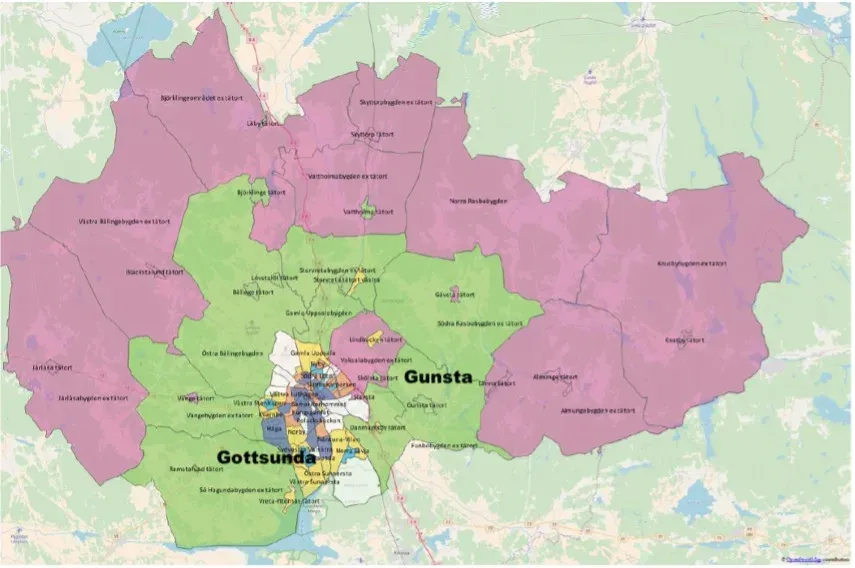
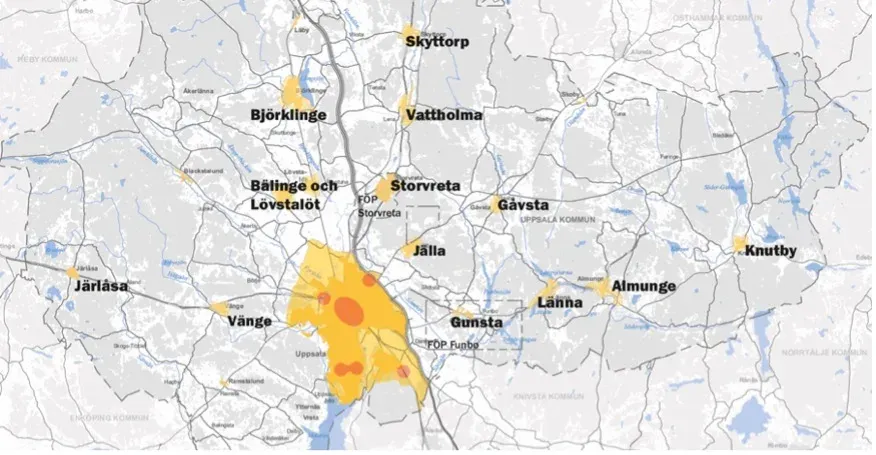
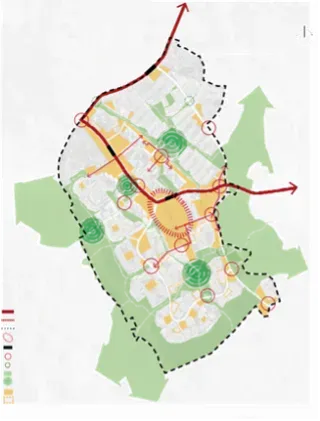
Furthermore, at the discursive level the green spaces in Gottsunda are described as ‘empty’, ‘dangerous’, or ‘valueless’ particularly in rental high-rise building blocks, or more density is simply assumed as providing more social meeting (Uppsala Kommun 2019) as in seen in other Million Program areas (see Mack 2021; Zalar and Pries 2022). Densified areas particularly consisted of roadside green stripes, smaller green spaces in the middle of housing groups, parts of courtyards, shopping centers, while remained near home environments and newly established parks usually designed to be visually controlled, highly programmed and materially plain (Figure 3) (Uppsala Kommun 2019) ‘defensible spaces’ (Newman 1972). The densified and altered landscapes are where green and public spaces are much needed due to the limited home spaces, to their potential for socialization within the housing block, and considering the population’s relative lack of access to other green areas16.
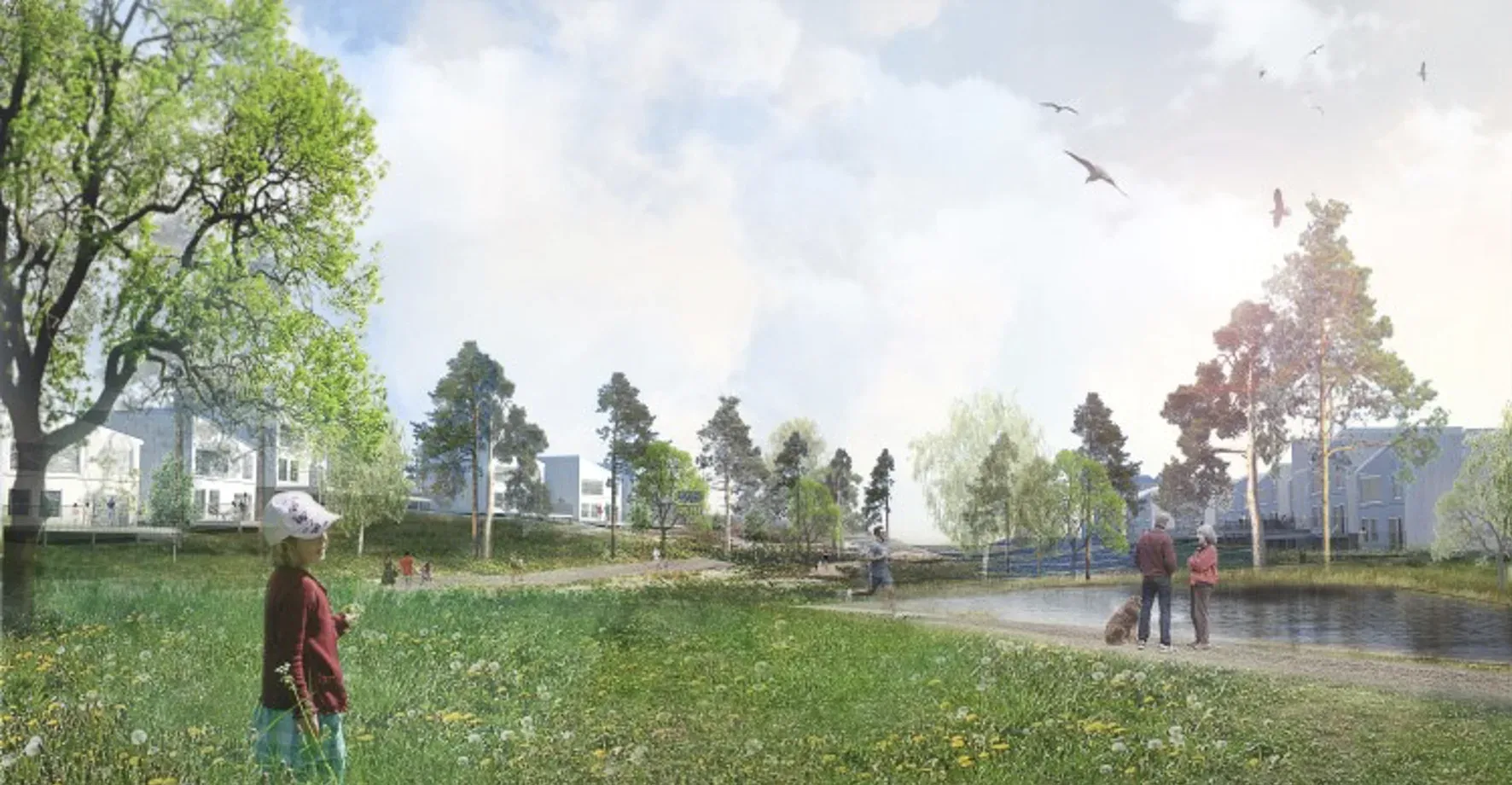
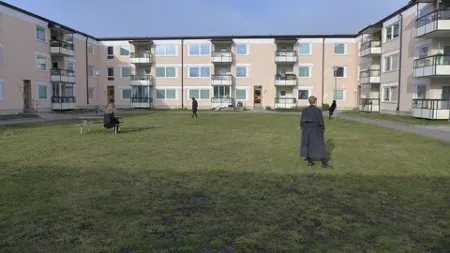
In parallel to rental areas in Million Program areas, in Gunsta, new low-density, detached, or semi-detached single-family housing areas are planned not to harm culturally valuable landscapes (see Uppsala Kommun 2010), grabbing less valuable forest lands in the periphery and increasing urban sprawl. Designed landscapes are mostly unprogrammed and untouched by concrete and other artificial landscape elements (see Uppsala Kommun 2017) (Figure 4).
Figure 3. the densified areas in Gottsunda are marked with yellow (Uppsala Kommun 2019)
Consequently, density and visually controlled bare open spaces sediment as an image referring to living environments of non-White bodies, whereas images of untamed socially un/or less-controlled natural areas and of White bodies merge perpetuating the historical racialized social construction of nature17.
Alongside the loss of green spaces for densification, alteration of green spaces in residential housing areas have become a pattern in Uppsala. In other cases, such as Gränby, it has been observed that uprooting trees and shrubs on beloved spots supposedly for ‘safety’ and ‘security’ left to the communities living in those areas, emotional scars as well as scars to their social and physical well-being (Pull and Richard, 2021) (Figure 5). Living in those areas means constant symbolic, social, economic and material losses (ibid.). In a similar vein, Mack (2021) expresses that the residents of those areas develop an “impossible nostalgia”. The fact that those losses are based on race and class become visible when looking at the particular relational dynamic of material and symbolic landscape dispossession and landscape grabbing.
In their geographic contexts as well as internationally, the theories we have aligned are particularly marginalized in the fields of urban theory (Wilder, 2020), planning and architecture, and may be even more so in landscape architecture, whose professional image and marketing are heavily constituted on ‘green orthodoxy’. Goetz et al. (2020) claim that uncomfortable questions regarding histories and contemporary forms of racialization and Whiteness in planning and design are oftentimes ignored and avoided both in research and education conforming the status quo in society. If White socio-spatial epistemology is not consciously challenged, planning practice might easily comply with normalizing common-sense discourses (ibid.). However, this is not an easy task in Sweden. Along with the construction of the Swedish welfare state in post-WW2 Sweden, a depiction of the country as free from racism has dominated, despite increasing discrimination against non-White Swedes (see Lotfsdottir and Jensen 2012; Hübinette 2012; Keskinen et al., 2009; Pred, 2000). Many scholars (cf. de los Reyes, Molina, & Mulinari 2005, Hübinette 2013, and Lundström & Hübinette 2020) in Sweden argue that there is an inhibition of international terminology and theoretical tools concerning construction of race in Sweden. In turn, the lack of analytic language and theories not only hides how race is constructed and operates in Sweden, but also risks actively reinforcing it (Pred, 1997). Ahmed (2012) stresses being over race is not anti-racism while racism still exists, on the contrary it conceals how race, White power and privilege are (re)produced, thus contributes to its reproduction. As we argue in this paper, Whiteness and green exceptionalism constitute the operating epistemologies (the canon) in planning in Sweden and obstruct comprehending how racialization sediments in landscape and plays role in segregation dynamics. The avoidance and tactics of bypass in the theoretical realm comes at a scholarly and social cost. It contributes to the maintenance of the mechanisms of inequality and spatial confinement of minoritized groups and blurs the border between theory and practice. Our case study of Uppsala shows that theory is connected with social practice against the “false assumption that theory is not a social practice” as hooks argues (2011 p.5.). Against such backdrop, “Say(ing) Its Name – Planning Is the White Spatial Imaginary” (Brand 2018), “confronting the White side of planning” becomes a project if White planning is wished to be replaced by reparative planning (Williams 2020) and White futures (Baldwin 2012) is wished to be foreclosed. Furthermore, this project calls for a critical, reflexive scholarship in the landscape architecture, urban planning and design fields without falling into common sense ‘green exceptionalism’. The scholarship from the other side of the Atlantic, ‘learning from outside the canon’, provides us the theories and languages to start building our own in the absence of theory, methodology and language, and require us to further develop the pedagogies to engage with wider public.
Furthermore, while deciphering Whiteness in planning as operating invisible power through non-relationality, essentialism, ignorance of historical injustices, these theories also suggest relational, performative, overtly anti-racist approach to landscape and planning epistemology in order to address and repair injustices. Such a project brings more questions to the table to explore in the future: What might the relational, performative, overtly anti-racist approach to landscape and planning epistemology and practice look like in the Swedish context? What could the discursive tools and tactics be to overcome obscuring effects of existing ones, such as ‘planning for all’? How can one be an anti-racist planning and design researcher, or practitioner? How could planning and design researchers and practitioners gain autonomy, reflexivity and critical thinking not to reproduce dominant values and meanings in the urban landscapes? What kind of knowledges and methodologies could anti-racist socio-spatial epistemology include? How would curricula of planning and design programs look? How could Whiteness, White knowledges in planning and design schools, research and practice be decentered?
Footnotes
-
The accountings in this paper mainly draw on the research for this paper. Full paper was submitted to an academic journal in December 2021. It is currently under review. Back to text
-
The Million Homes Programme was initiated by the Swedish government aiming at ending the housing deficit building a million new dwellings between 1965-1974 (Hall and Viden 2005). The projects were usually located in the peripheries of big cities, where cheap land is available (ibid.). they became gradually stigmatized within interwoven negative media representations in relation to housing architecture, unfinished environments and the ‘immigrant background’ population (Molina 2018). Back to text
-
see https://rwi.lu.se/podcasts/on-campaining-against-racism-in-sweden-podcast-with-isatou-aysha-jones-founder-of-black-lives-matter-sweden/ Back to text
-
Annica Hult, Black Lives Matter brings sharper focus to the situation in Sweden, 12 October 2020 see https://www.uu.se/en/news/article/?id=15512&typ=artikel&lang=en ; Isatou Aysha Jones, 2021, see https://rwi.lu.se/podcasts/on-campaining-against-racism-in-sweden-podcast-with-isatou-aysha-jones-founder-of-black-lives-matter-sweden/ Back to text
-
It refers to “Black, Indigenous, (and) People of Color” see https://www.merriam-webster.com/dictionary/BIPOC Back to text
-
Robert Stasinski, 2020, Weak Response to Black Lives Matter in Sweden, see https://kunstkritikk.com/weak-response-to-black-lives-matter-in-sweden/ Back to text
-
Search on Scopus with keywords landscape, Sweden, Whiteness, race, planning, design hits zero source (dated February 2022). There is one publication with slightly different keyword combination (Whiteness, environmental injustice, planning) Bradley, K., Gunnarsson-Ostling, U. and Isaksson, I. (2008). Exploring Environmental Justice in Sweden—How to improve planning for environmental sustainability and social equity in an ‘eco-friendly’ context”. Projections—MIT Journal of Planning 8: 68–81. Back to text
-
In Swedish context, Whiteness is constructed through different othering processes in different periods (see Idevall Hagrin 2021). Whereas, historically, othering ideologies within European colonialism relationally constitute of Whiteness and White supremacy in Sweden (ibid.), today ‘invandrare’, immigrant, is used to ‘other’ a wide range of people and operates as a category of otherization, and consequently relationally construct Whiteness, White privilege and Whiteness as norm (Runfors 2016; Lundström 2017), while colonial ideologies still linger and take other forms (see Idevall Hagrin 2021). Back to text
-
see https://www.hallbarstad.se/almedalen-2019-mojligheter-for-hallbar-stadsutveckling/ Back to text
-
This statement comes from just after another one arguing all residential areas should have equal green spaces and cancels that one (ibid.). Back to text
-
For more on the social construction of ‘us’ and the ‘others’ binary in Sweden see Pred, A. (2000). Even in Sweden: Racisms, Racialized Spaces, and the Popular Geographical Imagination, University of California Press. Back to text
-
For example, see Thapar-Björkert, S., Molina, I., & Villacura, K. R. (2019). From welfare to warfare: Exploring the militarisation of the Swedish suburb. In Undoing Homogeneity in the Nordic Region. Routledge; Lunabba, N. (2020) We need to think beyond the baton – debate article (English translation). https://www.expressen.se/kvallsposten/debatt-kvp/vi-maste-tanka-langre-an-vad-batongen-racker/ Back to text
-
For coloniality and racism in social construction of nature in Sweden see Hagrin-Idevall (2020); for racialization of space and racism in constitution of spatial science and thinking in Sweden see Olwig (2017;2018); for experienced anti-blackness in urban and natural spaces see Skinner (2019). Back to text
-
We use White instead of white to highlight its constructed power position rather than simply an ethnic group belonging. Back to text
-
For more on how these analysis and representation tools work to dispossess see our article “White landscapes: tracing socio-spatial epistemologies of Whiteness in contemporary Swedish planning” that we presented its first version during the workshop is currently under review. Back to text
-
Ibid. Back to text
-
For historical racialized social construction of nature see Hagren-Idevall, K. (2020). Nature, modernity, and diversity: Swedish national identity in a touring association’s yearbooks 1886–2013. National Identities, 0(0), 1–18. https://doi.org/10.1080/14608944.2020.1803819 and Mels, T. (2002). Nature, Home, and Scenery: The Official Spatialities of Swedish National Parks. Environment and Planning D: Society and Space, 20(2), 135–154. https://doi.org/10.1068/d14s Back to text
References
- Ahmed, S. (2012) On Being Included: Racism and Diversity in Institutional Life. Duke University Press.
- Angelo, H. (2019) ‘Added value? Denaturalizing the “good” of urban greening’, Geography Compass, 13(8), p. 12459. Available at: https://doi.org/10.1111/gec3.12459.
- Backvall, K. (2019) Constructing the Suburb: Swedish Discourses of Spatial Stigmatisation. Doktorsavhandling, sammanläggning. Uppsala University, Institute for Housing and Urban Research.
- Baldwin, A. (2012) ‘Whiteness and futurity: Towards a research agenda’, Progress in Human Geography, 36(2), pp. 172–187. Available at: https://doi.org/10.1177/0309132511414603.
- bell hooks (1991) ‘Theory as Liberatory Practice’, Yale Journal of Law and Feminism, 4, pp. 1–12.
- Bentsen, P., Lindholst, A.C. and Konijnendijk, C.C. (2010) ‘Reviewing eight years of urban forestry & urban greening: Taking stock, looking ahead’, 9, pp. 273–280. Available at: https://doi.org/10.1016/j.ufug.2010.06.003.
- Braae, E. et al. (2021) ‘European mass-housing welfare landscapes’, Landscape Research, 46(4), pp. 451–455. Available at: https://doi.org/10.1080/01426397.2021.1914568.
- Brand, A.L. (2018) Say Its Name-Planning Is the White Spatial Imaginary. or Reading.
- Brand, A.L. (2021) ‘The sedimentation of whiteness as landscape’, Environment and Planning D: Society and Space, pp. 1–16.
- Connolly, J.J. (2019) ‘From Jacobs to the Just City: A foundation for challenging the green planning orthodoxy’, Cities, 91, pp. 64–70. Available at: https://doi.org/10.1016/j.cities.2018.05.011.
- Dwyer, O.J. and Jones, P. (2000) ‘White socio-spatial epistemology’, Social & Cultural Geography, 1(2), pp. 209–222. Available at: https://doi.org/10.1080/14649360020010211.
- Goetz, E.G., Williams, R.A. and Damiano, A. (2020) ‘Whiteness and Urban Planning’, Journal of the American Planning Association, 86(2), pp. 142–156. Available at: https://doi.org/10.1080/01944363.2019.1693907.
- Gould, K. and Lewis, T. (2016) Green Gentrification: Urban sustainability and the struggle for environmental justice. Routledge.
- Hall, T. and Vidén, S. (2005) ‘The Million Homes Programme: A review of the great Swedish planning project’, Planning Perspectives, 20(3), pp. 301–328. Available at: https://doi.org/10.1080/02665430500130233.
- Jones, M. (2018) Defining Landscape Democracy: A Path to Spatial Justice. Cheltenham: Edward Edgar Publishing, pp. 16–28.
- Keskinen, S. et al. (2009) Complying With Colonialism: Gender, Race and Ethnicity in the Nordic Region. Routledge.
- Kommun, U. (2016) Overall City Plan. Available at: https://uppsalakommun.maps.arcgis.com/apps/MapJournal/index.html?appid=e3411adb873a48439fa6eb8c331f5811.
- Kommun, U. (2017a) Comprehensive Plan Uppsala 2050. Uppsala kommun. Available at: https://www.uppsala.se/kommun-ochpolitik/.
- Kommun, U. (2017b) Plan Description for Södra Gunsta etapp 2. Retrieved November 14. Available at: https://bygg.uppsala.se/globalassets/uppsala-vaxer/dokument/stadsplanering-.
- Kommun, U. (2017c) Rural Programme for Uppsala Municipality. Available at: https://www.uppsala.se/contentassets/f3418d40642449b2baa2e176f154bd17/landsby.
- Kommun, U. (2018) Social Compass. Available at: https://www.uppsala.se/contentassets/35350f7719c348b382efe14ceb97b301/den-socialakompassen—nio-nyanser-av-uppsala.pdf.
- Kommun, U. (2019) Plan Programme for Gottsunda. Available at: https://www.uppsala.se/kommun-och-politik/publikationer/planprogram-forgottsundaomradet/.
- Lipsitz, G. (2007) ‘The Racialization of Space and the Spatialization of Race: Theorizing the Hidden Architecture of Landscape’, Landscape Journal, 26, pp. 10–23.
- Lipsitz, G. (2011) How Racism Takes Place. Temple University Press.
- Loftsdóttir, K. and Jensen, L. (2012) Whiteness and Postcolonialism in the Nordic Region: Exceptionalism, Migrant Others and National Identities. Routledge. Available at: https://www.routledge.com/Whiteness-and-Postcolonialism-in-the-Nordic-Region-Exceptionalism-Migrant/Loftsdottir-Jensen/p/book/9781138266971.
- Mack, J. (2021) ‘Impossible nostalgia: Green affect in the landscapes of the Swedish Million Programme’, Landscape Research, 46(4), pp. 558–573. Available at: https://doi.org/10.1080/01426397.2020.1858248.
- Mceachrane, M. (2018) ‘Universal Human Rights and the Coloniality of Race in Sweden’, Human Rights Review, 19(4), pp. 471–493. Available at: https://doi.org/10.1007/s12142-018-0510-x.
- McKittrick and Woods as Planning Text (no date), pp. 254–288.
- Molina, I. (2018) ‘Planning for Patriarchy? Gender Equality in the Swedish Modern Built Environment’, in A. Staub (ed.) The Routledge Companion to Modernity, Space and Gender. Routledge, pp. 26–40. Available at: https://doi.org/10.1201/9781315180472-4.
- Pred, A. (1997) ‘Somebody Else, Somewhere Else: Racisms, Racialized Spaces and the Popular Geographical Imagination in Sweden’, Antipode, 29(4), pp. 383–416. Available at: https://doi.org/10.1111/1467-8330.00053.
- Pred, A. (2000) Even in Sweden: Racisms, racialized spaces, and the popular geographical imagination. University of California Press.
- Pull, E. and Richard, Å. (2021) ‘Domicide: Dis place ment and dispossessions in Uppsala’, Sweden. Social & Cultural Geography, 22(4), pp. 545–564. Available at: https://doi.org/10.1080/14649365.2019.1601245.
- Tahvilzadeh, N. (2021) Kris och politik mot segregation: Generella eller selektiva åtgärder? EXTERNA PERSPEKTIV Segregation och.
- Thörn, C. et al. (2010) Swedish cities now belong to the most segregated in Europe. Available at: https://bygg.uppsala.se/contentassets/ff822fe23eba40d9899293673cde294e/fop_funbo_antagandehandling.pdf.
- Wilder, M. (2020) ‘The enduring significance of race and ethnicity in urban communities’, Ethnicity and the City, 1(1–2), pp. 1–5. Available at: https://doi.org/10.1080/26884674.2020.1787755.
- Williams, R.A. (2020) ‘From Racial to Reparative Planning: Confronting the White Side of Planning’, Journal of Planning Education and Research, pp. 0739456X – 20946416.
- Zalar, A. and Pries, J. (2022) ‘Unmapping green space: Discursive dispossession of the right to green space by a compact city planning epistemology’, City, 26(1), pp. 51–73. Available at: https://doi.org/10.1080/13604813.2021.2018860.
About the authors

Burcu Yigit Turan
I am a senior lecturer in the subject area of ‘planning in cultural environments’ at the Swedish University of Agricultural Sciences, Department of Urban and Rural Development, Landscape Architecture Division, Uppsala. My works have developed at the intersections of architecture, landscape, urbanism and critical social theory and cultural studies. In my research, I have focused on reproduction of social inequality in spatial planning and design. My recent works delineate the role of public space and landscape production in urban bordering, (neo)colonial urbanism, racialization and segregation.

Mia Ågren
Swedish University of Agricultural Sciences - SLU
Mia Ågren is a PhD Student at the division of Landscape Architecture at the Swedish University of Agricultural Sciences. Drawing on her bachelor in Sociology and Master in Environmental Communication she combines Critical Race theory and urban landscape theory to explore systematic bias in Swedish Municipal green space planning and practice towards non-White populations.
Cite this article
Harvard
Turan, B.Y. and Ågren, M. (2022) ‘Segregation and Landscape Injustice in the Shadows of White Planning and Green Exceptionalism in Sweden’, Urban Matters, 3. Available at: https://urbanmatters-staging.leadm.site/articles/segregation-and-landscape-injustice-in-the-shadows-of-white-planning-and-green-exceptionalism-in-sweden/.
APA
Turan, B. Y., & Ågren, M. (2022). Segregation and Landscape Injustice in the Shadows of White Planning and Green Exceptionalism in Sweden. Urban Matters, 3. https://urbanmatters-staging.leadm.site/articles/segregation-and-landscape-injustice-in-the-shadows-of-white-planning-and-green-exceptionalism-in-sweden/
BibTeX
@article{turan2022segregation,
  author = {Turan, Burcu Yigit and Ågren, Mia},
  title = {{Segregation and Landscape Injustice in the Shadows of White Planning and Green Exceptionalism in Sweden}},
  journal = {Urban Matters},
  year = {2022},
  volume = {3},
  issn = {2004-206X},
  publisher = {Institute for Urban Research, Malmö University},
  url = {https://urbanmatters-staging.leadm.site/articles/segregation-and-landscape-injustice-in-the-shadows-of-white-planning-and-green-exceptionalism-in-sweden/}
}